 George Patton, Lord Glenalmond (November 1803 – September 20, 1869), was a prominent Scottish judge, legal scholar, and Conservative politician whose life
combined a distinguished academic and legal ascent with a tragic end.
George Patton, Lord Glenalmond (November 1803 – September 20, 1869), was a prominent Scottish judge, legal scholar, and Conservative politician whose life
combined a distinguished academic and legal ascent with a tragic end.
Queer Places:
University of Glasgow, University Avenue, Glasgow G12 8QQ
University of Cambridge, 4 Mill Ln, Cambridge CB2 1RZ
Glenalmond (historically also referred to as the Logiealmond estate), Perth PH1 3TG, United Kingdom
Monzie Churchyard, Crieff PH7 4HE, United Kingdom
George Patton, Lord Glenalmond (November 1803 – September 20, 1869), was a prominent Scottish judge, legal scholar, and Conservative politician whose life
combined a distinguished academic and legal ascent with a tragic end.
Born in Perth, Scotland, in November 1803, he was the third son of James Patton, a sheriff-clerk of Perthshire from the Cairnies. His early education took him through the local schools of Perth, the Glasgow School, and Glasgow University, where he matriculated and earned his Bachelor of Arts degree in 1820. Continuing his academic journey southward to the University of Cambridge, he entered Trinity College on June 17, 1822, where he distinguished himself as a scholar in 1825 and earned another BA in 1826, successfully navigating both the Mathematical and Classical Triposes. During his time at Cambridge, he was notably admitted as a member of the elite and intellectually influential secret society known as the Cambridge Apostles.
Returning to Scotland to pursue a legal career, Patton was admitted to the Faculty of Advocates in 1828, establishing a solid reputation within the Scottish legal establishment. His professional rise culminated in high-ranking governmental and judicial appointments. In 1859, he was appointed Solicitor General for Scotland under the Conservative administration. Expanding his career into parliamentary politics, he was elected as the Member of Parliament for Bridgwater, Somerset, serving from August 1865 until March 1866. Following this brief tenure in the House of Commons, he achieved his party's highest Scottish legal office when he was appointed Lord Advocate of Scotland in 1866, subsequently becoming a Privy Counsellor in November 1867. Later that year, in 1867, he elevated himself to the supreme Scottish judiciary, being appointed Lord Justice Clerk and assuming the judicial title of Lord Glenalmond. In 1869, following the death of his elder brother Thomas, he succeeded to the family estate of Glenalmond in Perthshire.
Despite his professional prestige, Patton's final years were overshadowed by political controversy and personal crisis. His judicial appointment as Lord Justice Clerk was widely criticized by contemporaries, with accusations that he had maneuvered the promotion partly to evade parliamentary inquiries into severe charges of election bribery and corruption tied to his political campaigns. Plunged under intense public scrutiny and personal suspicion, his mental state deteriorated rapidly. On September 20, 1869, at the age of 65, he died by his own hand, drowning in the River Almond at Glenalmond, Perthshire.
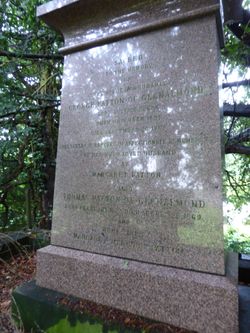
Regarding any links to LGBTQ+ history, standard historical records, contemporary obituaries, and his biographers document no evidence or suggestion of same-sex relationships or non-traditional romantic inclinations; he was heterosexually married in 1857 to Margaret Malcolm Bethune, who survived him and erected a memorial table in his honor. His remains were interred on September 28, 1869, in Monzie Parish Churchyard near Crieff, laid alongside his brother Thomas—who had passed away just four weeks prior—in a funeral attended by local relatives, neighbors, and grieving villagers.
References:
 The Cambridge Apostles, 1820-1914: Liberalism, Imagination, and Friendship in British Intellectual and Professional Life 1st Edition by W.C. Lubenow |
Other references:
Support this project
This website is a passion project researched, developed, and funded entirely by me. If you find the content valuable and would like to help support the ongoing research and hosting costs, any contribution is deeply appreciated.
Thank you for keeping this independent resource alive!
My books on Amazon: Elisa Rolle's books